
Picture credit
When my first serious relationship ended soon after I began college, I was devastated and heartbroken. Over and over again, my friends told me that I would meet someone new eventually. Besides, I shouldn’t focus on that. College is about starting a new chapter of life, trying new things, and enjoying youth to its fullest extent. Stop looking for something so serious, they’d tell me.
What my friends told me is the thought process that many of us have. College is our first time living away from home, free from our parents’ nagging and supervision. We want to learn, experiment, and grow in different ways, including sexually.
College students can experience sex that takes place to fulfill both parties’ sexual desires. A hook up is when you are physically intimate with a person on a one-time occasion. Other forms of casual sex also exist, such as friends with benefits relationships, wherein it occurs between two friends on a regular basis. Even though our elders may deem us to be sex-crazed and depraved morally, sex practices in the United States hasn’t really changed much since the 1960s. Instead, it is that the qualifications for sexual relationships have relaxed; love and intimacy are no longer expected because sex is more open.

Picture credit
Hooking up in the modern era
Casual sex is preferred over a relationship by those who are busy. In a New York Times article, A., a student at the University of Pennsylvania, said, “And I know everyone says, ‘Make time, make time [for a romantic relationship].’ But there are so many other things going on in my life that I find so important that I just, like, can’t make time, and I don’t want to make time.” Ambitious students like A. spend most of their waking hours “grinding,” striving to expand their list of impressive accomplishments to ultimately receive the best, elite job offer they possibly can. Committing to a time-consuming relationship that isn’t guaranteed to be long-term, especially when there’s a mindset that there is always someone better who will come around, isn’t economically beneficial. Thus, hook ups allow us students to still enjoy the occasional physical intimacy while focusing on our future.

Picture credit
Casual sex practices have become more transparent and open. A study found that 50-75% of college students have hooked up with at least one person in the last 12 months. Furthermore, 20% of college women and 25% of college men nationally were reported to have hooked up with a total of 10 or more people. One Time article’s understanding of the characteristics of modern-day sex may explain these high rates of casual hook ups: “Love is no longer a prerequisite for sexual intimacy; and nor, for that matter, is intimacy a prerequisite for sex.” People prefer casual sexual relationships over long-term love for various reasons, one being the hefty time commitment of a relationship, as previously mentioned. Love and intimacy were expected in a sexual relationship for people born before 1980 and reached their 20s in the 2000s. This may be why younger generations nowadays are thought to be sex-driven, apathetic, and depraved of morality by older generations.
The impact of the sexual revolution (1960s-1980s)
The sexual revolution in the United States was triggered by the feminist movement, which encouraged women to be more prominent in the political and economic spheres of society and gaining public rights. The sexual revolution emphasized the acknowledgement that women who now became busier than before, enjoy and desire sex just like men. At the same time, oral contraceptives were invented and became readily accessible, allowing for sex to be practiced with a lower risk of pregnancy. These factors significantly increased the rate and social acceptance of premarital sex.

Picture credit
In the next two decades, the oral pill became more widely accepted by society, and the conversation revolving around sex became more open. Premarital sex—and, ultimately, the hook up culture—continued to become more prevalent. For example, a longitudinal study published in 1977, in which the researchers collected data on the same group of college students in 1965, 1970, and 1975, found that the percentage of women who started to partake in premarital sex grew substantially more during these intervals (29%, 37%, and 57% in the three respective years) than men (65%, 65%, and 74%).
Have things changed since the 1980s?
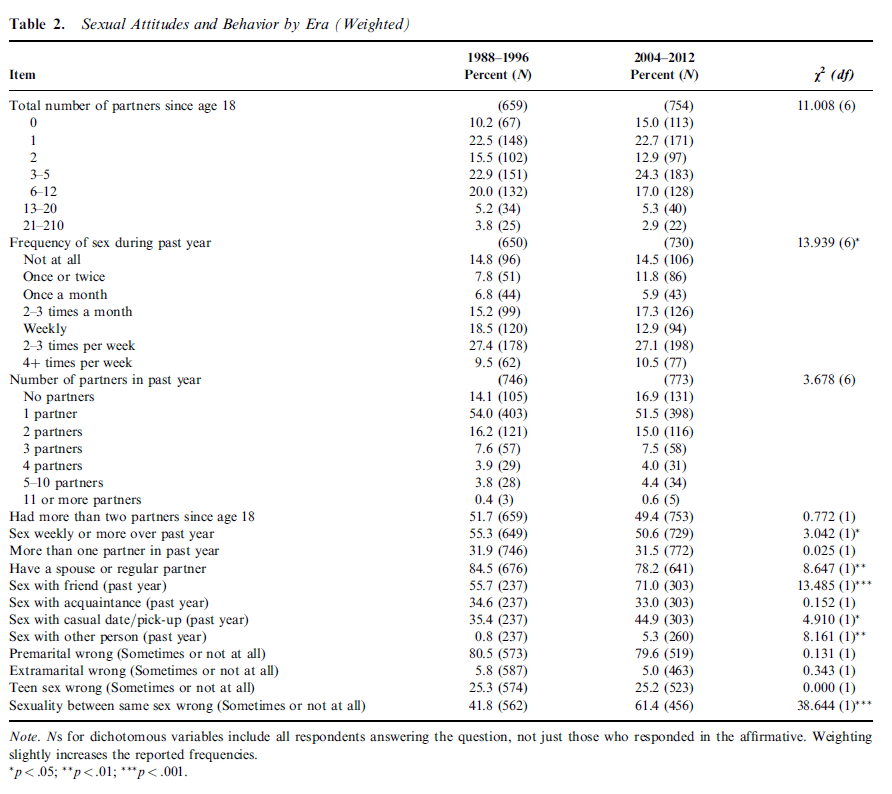
Some of us might assume that the number of people engaging in sex may have continued to grow significantly since the sexual revolution, especially with new contraceptive methods having been developed since the invention of oral pills. However, a study found that the General Social Survey (GSS) responses from the 2004-2012 wave report the same number of sexual partners and sexual encounters as the responses from the 1988-1996 wave. This means that the frequency and openness to sex in the United States has remained relatively constant since the sexual revolution.
Picture credit
The major difference between these two eras’ responses is that we now tend to have more sex with casual partners. This may be due to a changed cultural understanding of premarital sex. Because we grew up in an era in which sex has always been portrayed as safer from consequences than older generations’, we may be more open to casual hook ups. Even though a higher number of young people started to engage in premarital sex during the sexual revolution, they were still exposed to the traditional way of thinking: there’s a high chance of getting pregnant, so you better love, or at least know very well and have some sort of positive feelings for, your sex partner. We, for the most part, have not been exposed to this line of thinking to the same extent. (If anything, we are told to practice safe sex so we do not have an unwanted pregnancy or STI[s]. Even if these occur, there are ways to handle these problems.)
Our openness to casual sexual encounters that lack emotional connection has made college hook ups appealing. More specifically they are portrayed as actions that are supposed to help us have the “fullest” college experience and try new things that we’ll probably not continue later on in life. While our parents may definitely disapprove of these encounters, it is very likely that it is more so because they are worried about our well-being than because they find premarital sex unacceptable.
 Explaining Human Behavior